Unboxing Experience: How Small Brands Design One
Updated · Vorex Packaging
An unboxing experience is the sequence a customer goes through from receiving a parcel to holding the product: the outer box, the reveal, the inner wrapping, the product and anything left behind, like a card. Small brands design one by planning each layer on purpose, printing where it is seen, and keeping it simple enough to pack quickly.
What an unboxing experience is
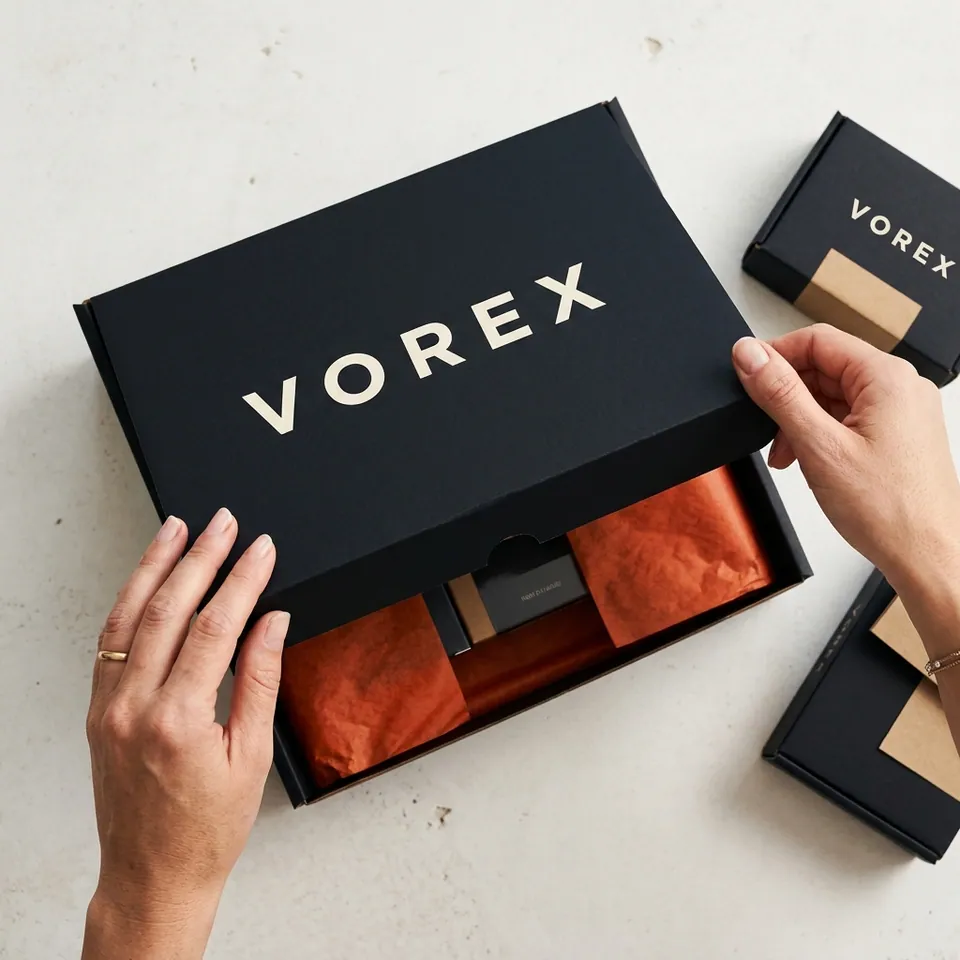
Every parcel is opened in a certain order. The customer sees the outside of the box, opens it, moves something aside, finds the product and then notices whatever else is in there. An unboxing experience is that order, designed on purpose. For a small brand it is one of the few moments you have the customer's full attention, in their own home, without a competitor one click away.
Designing it well is less about adding extras and more about deciding what the customer should see at each step. A plain box with a printed message inside the lid, product wrapped neatly and a short card can feel more considered than a box packed with loose filler and flyers.
Map the opening sequence first
Before you choose materials, write the sequence down as a list of moments. A typical one looks like this:
- Arrival: the parcel on the doorstep or in the mailroom.
- Opening: the tear strip, tape or tuck lid.
- Reveal: the first thing seen when the lid lifts.
- Unwrapping: tissue, a sleeve or an inner box.
- Product: how it sits, and how easily it lifts out.
- After: the card, sample or instruction that stays behind.
Then decide what each moment should do. The reveal is usually where your brand should speak loudest. The product moment should feel secure and easy. The after moment is where you ask for something, such as a review, a reorder or a follow on social media.
Unboxing experience ideas, layer by layer
The outer box
Corrugated custom mailer boxes are the standard choice for direct-to-consumer brands because they ship well and open like a gift, with no tape across the top. A printed outside builds recognition, while a plain outside with a printed inside keeps contents discreet on a doorstep. Color sets the tone early: black mailer boxes feel dramatic, and our comparison of kraft vs white boxes covers the trade-offs for natural and clean looks.
The reveal
Print the inside of the lid. A short line of copy, a pattern or a simple mark is enough, and it is the one surface every customer looks at. Keep the message specific to your brand rather than a generic thank you.
Wrapping and closures
Branded custom tissue paper sealed with a custom sticker adds a second, small reveal and protects the product from scuffs. For premium products, an inner rigid box or a magnetic closure box inside the mailer gives a satisfying weight and closing feel.
Holding the product
An insert cut to your product holds it in place, stops movement in transit and presents items in a deliberate layout. Leave a finger notch or pull tab so the product lifts out without a struggle.
Copy and tone
Words carry much of the experience and cost little to change. Write the lid message, card and tissue pattern in the same voice as your website. Name the product, tell the customer one thing to do first, such as how to light a candle for the first time or how to store a serum, and keep it short enough to read in a few seconds. If you have a story worth telling, a founder note on the card is more personal than a printed slogan on the box.
What stays behind
A printed card, a hang tag or a product label with care instructions gives the box a useful last moment. Use it for one clear request rather than a stack of flyers.
Unboxing experience examples by product type
- Skincare and beauty: a mailer with a printed lid, tissue, and each bottle in its own carton such as serum boxes. The carton protects the bottle and carries ingredients and directions.
- Candles: a sturdy inner box or insert keeps glass vessels from knocking together. Custom candle boxes can carry scent notes and burn instructions on the side panels.
- Jewelry: a small jewelry box inside a padded mailer turns a light, low-volume order into a proper present.
- Apparel: folded garments in tissue inside a mailer, or a branded poly mailer for lighter, non-fragile orders.
- Food and treats: a windowed box or a printed lid lets the product make the first impression, and a simple liner keeps the box clean. See our custom cookie boxes for one example.
- Supplements and wellness: clean cartons with clear dosage panels build trust, and a printed card can explain how to start a routine.
- Subscription and PR kits: subscription boxes benefit from a consistent outer box with a changing insert or card, while PR boxes can go further on structure and finish since quantities are small.
Design for the camera and for the second order
Some customers will film or photograph the moment the lid opens, so design the reveal to read well from above: high contrast, a clear mark, and nothing that looks messy when shot on a phone. Keep finishes purposeful. A soft-touch lamination or a single foil detail can lift a box, but several effects competing on one surface rarely photograph well.
Think about the repeat customer too. A reveal that is exciting the first time can feel wasteful the fifth time. Subscription brands often keep the outer box consistent and change a small, cheap element each month, such as a card, sticker or tissue color, so the experience stays fresh without new box tooling.
Make the box easy to open. A tear strip or a tuck lid that opens without a knife is kinder to customers and avoids scratched products. Check that older customers or people with limited grip can lift the product out, and that small print on cards is large enough to read.
Make the second order feel recognized
Repeat customers notice when a brand remembers them. A different card for second orders, a printed note thanking returning customers, or a small sample of a product they have not tried yet can all be handled at the packing table with no change to the box itself.
Keep it practical: cost, waste and packing time
Every layer you add costs money and adds a step on the packing table. Before you commit, pack ten test orders and time them. If an element slows packing badly or is regularly forgotten, simplify it.
- Print where it is seen: an inside print often does more than full outside coverage.
- Right-size the box: a box made to your product needs less filler and can reduce dimensional weight charges.
- Choose recyclable materials: paper tissue, paper tape and corrugated board are easier for customers to put in curbside recycling than mixed materials, though local rules vary.
- Cut what nobody keeps: one useful card beats several flyers that go straight in the bin.
- Plan for breakage first: a beautiful reveal means nothing if the product arrives damaged, so test-ship a few boxes before committing to a design.
Track the result after launch. Customer messages, photos tagged with your brand and damage reports tell you which parts of the experience people notice and which ones they ignore, so each reorder can be a little more focused than the last.
If you sell on marketplaces, our guide to packaging for Etsy and Shopify sellers covers formats and sizing in more detail. When you are ready, request a free quote with your product sizes and the layers you want to include.